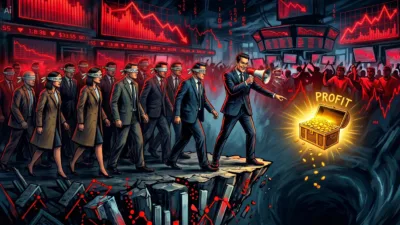

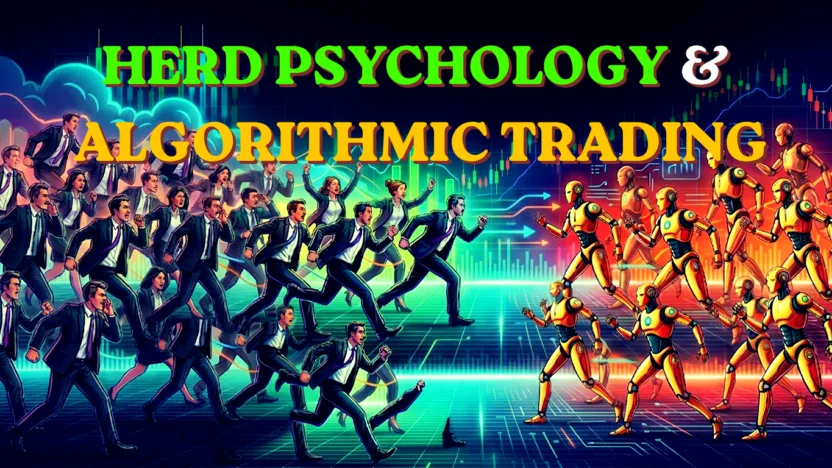
For nearly fifty years, behavioral finance has been one of the most powerful tools for explaining investor behavior in the financial world. As we tried to understand market bubbles, panics, excessive optimism, crashes, and herd behavior, we always came back to the same point: human psychology.
Investors were not always rational.
They feared losses, displayed overconfidence, followed the crowd, and often acted on their emotions. As a result, market prices would occasionally deviate from their true values.
However, today we face a very different question:
What if humans no longer make a significant portion of decisions in the market?
At first glance, this question may seem theoretical. Yet, on Wall Street, in London, and in the world’s major financial centers, this transformation has already begun. Today, a large portion of transactions in many markets is executed by algorithms. In some markets, this ratio has exceeded 70%.
In other words, a significant portion of the decisions that affect prices is no longer made by people who are afraid, excited, or caught up in herd mentality, but by mathematical models.
This is where the most important debate in financial theory for the coming years begins.
The Three Types of People in Finance
When we look back at the history of modern finance, we see three distinct human models.
The first model is Homo Economicus.
This investor accesses information, analyzes it, and strives to maximize their own interests as effectively as possible. Modern financial theory, developed by figures such as Harry Markowitz, William Sharpe, and Eugene Fama, is built on this assumption.
In this world, information is reflected in prices.
Errors are random.
Markets are efficient in the long run.
However, studies emerging after the 1980s began to challenge this picture.
Researchers such as Daniel Kahneman, Amos Tversky, and Richard Thaler demonstrated that investors are not as rational as we once thought.
People feared losing money more than they sought to make it.
They did not want to close losing positions.
They exhibited excessive self-confidence.
They followed the crowd.
Thus, Homo Economicus was replaced by Homo Psychologicus.
Behavioral finance was not merely a new theory. It was the financial world’s rediscovery of the human element.
However, today a third actor is stepping onto the stage:
Homo Algorithmicus.
Who Makes Decisions in the Markets?
Consider an investment fund.
In the past, research teams would analyze balance sheets, read industry reports, and make decisions in investment committees.
Today, however, a significant portion of these processes is carried out by software.
Algorithms analyze millions of data points in seconds.
They read company reports.
They scan news feeds.
They evaluate satellite imagery.
They process social media data.
Then they generate a buy or sell decision.
There is no fear in this process.
No excitement.
No greed.
The classic elements of human psychology seem to be disappearing.
But is that really the case?
Irrationality Doesn’t Disappear
Many investors believe that artificial intelligence and algorithms will make markets more rational.
At first glance, it seems logical.
If the source of errors is human psychology and machines are making the decisions, then the market should become more efficient.
However, history tells a different story.
On May 6, 2010, a historic event occurred in U.S. markets.
In a matter of minutes, approximately one trillion dollars in market value vanished.
Most of it was later returned.
This event is known today as the Flash Crash.
Was it panicking people?
No.
What caused the market to crash was the reactions of the algorithms triggered in one another.
A similar event occurred in 2013.
The Associated Press’s social media account was hacked, and a fake news story claiming an explosion at the White House was published.
The algorithms treated the news as real.
Sell orders started pouring in.
The market plummeted within seconds.
Once the news was corrected, prices rose again.
Once again, it wasn’t panicking people—it was the algorithms.
In 2012, the investment firm Knight Capital lost approximately $440 million in just 45 minutes due to a single software update error.
This time, the problem wasn’t psychology—it was a few lines of code.
It seems irrationality isn’t going away.
It’s just changing form.
New Risk: Algorithms Becoming Too Similar
Traditional finance’s greatest fear was herd behavior.
Today, a new type of herd behavior is emerging.
Algorithmic herd behavior.
The data sources used in the modern investment world are becoming increasingly similar.
The same economic data.
The same news feeds.
The same machine learning libraries.
The same optimization techniques.
As a result, funds that appear independent of one another often begin to generate similar signals.
This is where the real danger lies.
Because if everyone uses the same model during a crisis, they could all sell at the same time.
In this scenario, the problem isn’t that investors are panicking; it’s that the algorithms are reaching the same conclusion.
In the past, systemic risk arose because banks issued the same loans.
In the future, systemic risk may arise because they use the same algorithms.
From the Democratization of Information to the Data Aristocracy
This transformation has more than just technical consequences.
It also has economic and political consequences.
The history of finance is largely the history of the democratization of access to information.
The telegraph disseminated price information.
Bloomberg terminals accelerated the flow of information among professionals.
The internet provided access to individual investors.
Information reached increasingly broader audiences.
However, in the age of artificial intelligence, a new source of power is emerging.
Data.
More precisely, big data and computational capacity.
Today, the world’s largest funds are not merely advantaged by possessing more capital.
They also possess more data, stronger processing capacity, and more advanced models.
Therefore, future financial competition may be shaped not by access to information, but by the capacity to process it.
The aristocrats of the old world owned land.
The aristocrats of the industrial age owned factories.
The aristocrats of the AI era, however, may possess data and computational power.
The Second Evolution of Behavioral Finance
The first major achievement of behavioral finance was demonstrating that humans are not entirely rational.
We are now on the threshold of a second evolution.
The question is no longer why people make mistakes.
It is how algorithms make mistakes.
New concepts in financial theory are taking shape accordingly:
Computational bias.
Algorithmic reflexivity.
Model convergence.
Network-connected systemic fragility.
These could become as significant in the future financial literature as loss aversion or herd behavior are today.
Conclusion: Who Will Inflate the Bubbles of the Future?
For most of financial history, people were behind the crises.
The 1637 Tulip Mania.
The 1720 South Sea Bubble.
The 1929 Wall Street Crash.
The 2000 Dot-Com Bubble.
The 2008 Global Financial Crisis.
Human behavior was at the center of each one.
But in the future, we may face a different landscape.
Greedy investors might not create the next major bubble, but they might create bubbles that mimic one another.
Frightened investors might not trigger the next panic, but models that generate the same signals might.
The next systemic risk might not stem from indebted banks, but from artificial intelligence systems trained on the same data.
Perhaps the biggest question facing financial theory now is this:
As we strive to understand human irrationality in markets, is a new form of irrationality emerging right before our eyes?
If so, the investor of the future will have to analyze not only companies and economies but also algorithms.